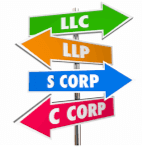
In the last decade or so, there has been a movement towards organizing small businesses as LLC’s (Limited Liability Companies)
As the name suggests, an LLC limits the legal liability (in case of a lawsuit) of your business to only the assets of the business and not to personal assets like your home and personal bank accounts.
An LLC is easy to set up by filing the proper forms with the state.
An LLC can be a one-owner business, a rental building, a partnership or even be converted to an S corporation.
Each form of doing business; the LLC, partnership and S corporation has its unique characteristics, benefits and disadvantages which should be considered and discussed with your tax advisor before forming any new business.
An LLC (Limited Liability Company) is a hybrid business tax structure that blends elements of partnerships, corporations and individuals.
The owner of an LLC is called a “member”. At the beginning of its business life, a member or members can decide to be treated for tax purposes as a partnership, an individual or as a corporation.
Unlike an individual or partnership, the LLC offers limited liability protections similar to a corporation. In a corporation, a shareholder is fully protected from creditors for corporate liabilities. In a partnership or individual there is no such protection. An LLC offers protection but only up to the member’s financial investment.
KEY FEATURES OF AN LLC
An LLC can be treated for tax purposes as a partnership, corporation or as an individual with its members enjoying certain limited liability protections under law.
Forming an LLC is simpler and faster than a corporation.
An owner or member cannot be on the payroll of an LLC. The member must take a draw and pay quarterly estimated taxes.
An LLC which is formed for a sole member (single member LLC) does not need to file a separate tax return.
An Operating Agreement which is agreed to by all members determines the rules of an LLC.
An Operating Agreement may be verbal.
Items of income, deductions, credits and distributions flow through to the members of an LLC in whatever proportions or percentages that are agreed to in the Operating Agreement.
LLC’s do not issue stock and are not required to hold annual meetings or keep written minutes.
LLC’s do not pay a separate income tax on profits. Profits, deductions, credits and distributions pass through to the individual members who pay their taxes on their annual 1040.
The biggest drawback to an LLC vs a corporation is that all profits are subject to social security taxes. In a corporation, you can structure profits to avoid social security taxes.
Always consult with your tax advisor before starting a new business to determine which form of business is best for your situation.