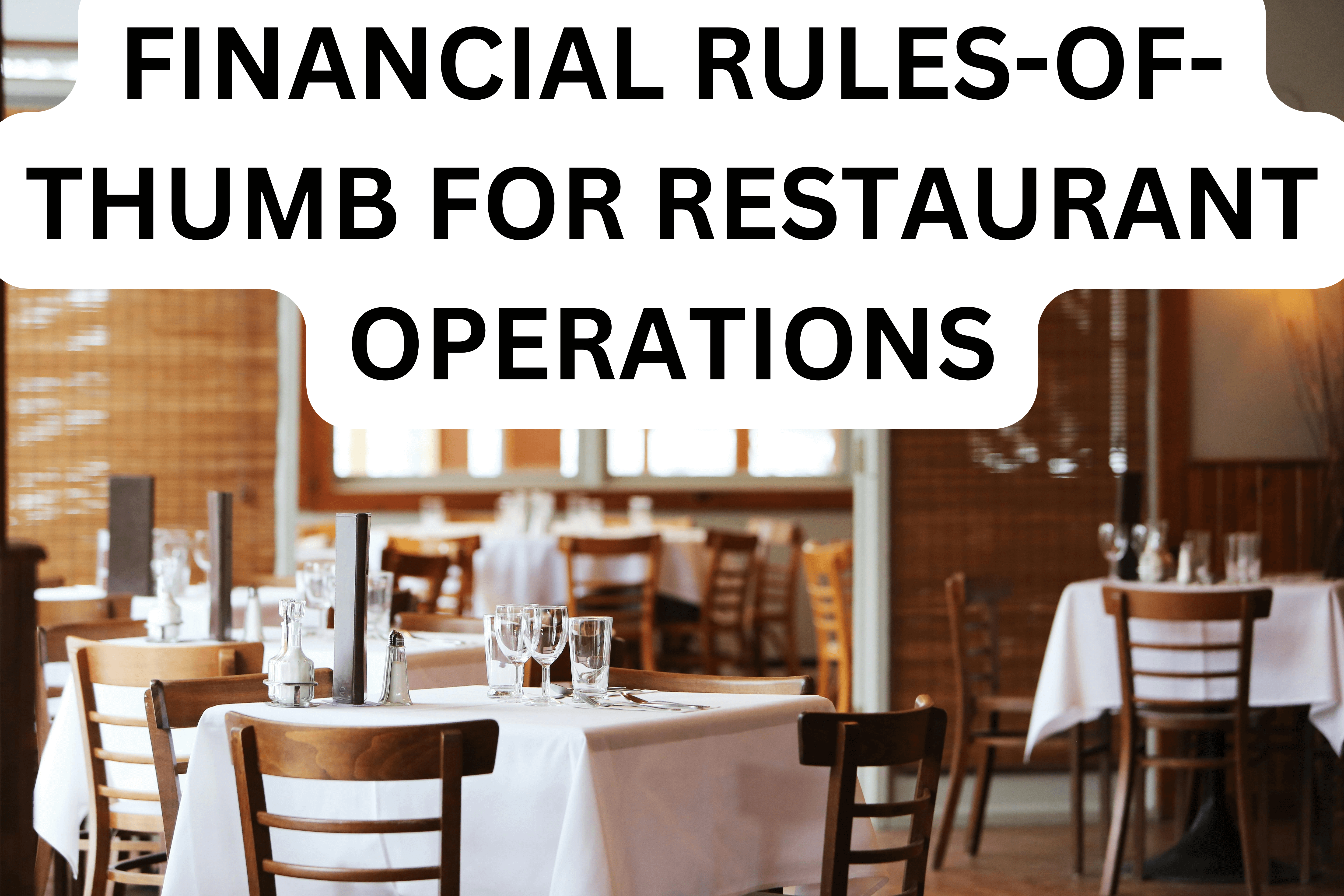
FINANCIAL RULES-OF-THUMB FOR RESTAURANT OPERATIONS
In my 48 years of experience, one thing I can say is that although there are some reasonably consistent financial rules of thumb for most restaurants, every independent restaurant is different.
There can be significant variability in such areas of overhead costs, occupancy costs, even food and beverage costs depending on a number of factors including the type of customer you are marketing to.
The ranges have been fairly reliable over the years and can give you at least a ballpark of what you should be aiming for but to really nail it, some fine tuning is necessary.
Also, realize that even if you are outside of these rules of thumb, you can still be profitable due to other factors.
Rules-of-thumb;
Sales needed based on monies invested if you rent space.
If you are renting your space, the rule of thumb says that your expected sales needs to be $1.50 for $1 in start up costs. For example, if it costs you $500,000 to build and open, your sales needs to be at least $750,000 per year.
Sales needed based on monies invested if you own your building.
If you own your space, the rule of thumb says that your expected sales needs to be $1.00 for $1.00 in start up costs excluding the cost of the building.
Sales per square foot.
Full-service restaurants with less than $200 of sales per square foot per year will have difficulty generating a profit. So, if your restaurant is 4000 square feet, you need at least $800,000 sales per year, approximately $67,000 sales per month and $15,000 sales per week. You can extrapolate your amounts based on your actual square footage.
Bar cost percentage.
Bar cost excluding wine should run between 15% and 20% of sales. Bottled beer as a subcategory will run 25% to 28%. Draft beer 15% to 18%. Wine rule-of-thumb is 35% to 45%.
Hourly employee gross payroll. (including payroll taxes and benefits)
For full-service restaurants: 30% t0 35%.
For limited service restaurants: 25% to 30%.
Management salaries.
Should not exceed 10% of sales in either a full or limited service restaurant.
Prime costs.
Prime costs is the most important number on your P & L and the most controllable. If your Prime costs are too high, you probably have a problem. Prime costs are your food and beverage costs plus labor costs combined.
For a full-service restaurant, 65% of sales or less.
For a limited-service restaurant, 60% of sale or less.
Occupancy costs.
Includes rent, insurances, real estate taxes, CAM charges
8% to 10%.
Its important to note that your particular operation could be outside these “rules-of-thumb” and still be highly profitable. The big key is sales per square foot. If you are very busy with tables full all the time, you could be running high food cost and correspondingly low labor. In addition, with high volume sales, your fixed overhead costs are fully covered and sales dollars then drop down to the bottom line.