TIP CREDIT COMPLICATES OVERTIME RULES

Employees who work over 40 hours in a week must be paid 1.5 times their hourly rate.
So, for example. If you pay a cook $20 per hour and he/she works 41 hours in a normal work week, you would have to pay that person $30 for that extra hour.
The calculation for overtime for tipped employees is somewhat different. For tipped employees, you must calculate the overtime rate based on the full minimum wage, not the lower tipped minimum wage.
The current minimum wage in Michigan is $10.33 per hour. The tipped minimum wage is $3.93 per hour.
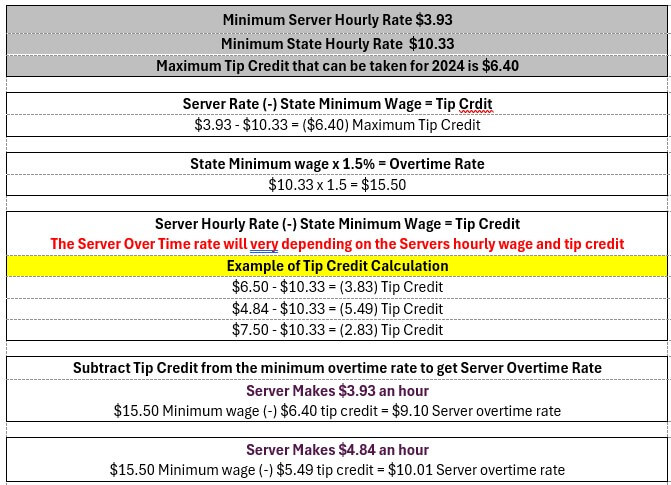
So, for a tipped employee you normally pay $4 per hour who works 41 hours and earns $300 in tips, the calculation would be as follows:
$4.00 – 10.33 = $6.33 (tip credit for this employee)
$10.33 x 1.5 = $15.50 (state overtime rate for tipped employees)
$15.50 – $6.33 (tip credit for this employee) = $9.17 (overtime rate for this employee)
Chart showing how tipped employees are treated for overtime:
A new overtime rule starting July 1, 2024 which may affect you requires that salaried workers who make less than $43,888 per year ($844 per week) must be paid overtime for time worked in excess of 40 hours per week.
You cannot just pay an employee a set amount to avoid overtime and call them a salaried employee. Salaried employees have a specific definition.
Salaried workers primarily perform executive, administrative or professional duties.
A salaried general manager or a manager of a department or subdivision of a restaurant may be considered exempt from overtime. Michigan Department of Labor has recognized restaurant managers, chefs, and administrative personnel as exempt from overtime in certain cases if they perform executive or administrative duties and/or direct a department and department employees and do not participate in other non-executive functions.
For more information on tipped overtime or salaried employees, call Julie at 313-962-6000.