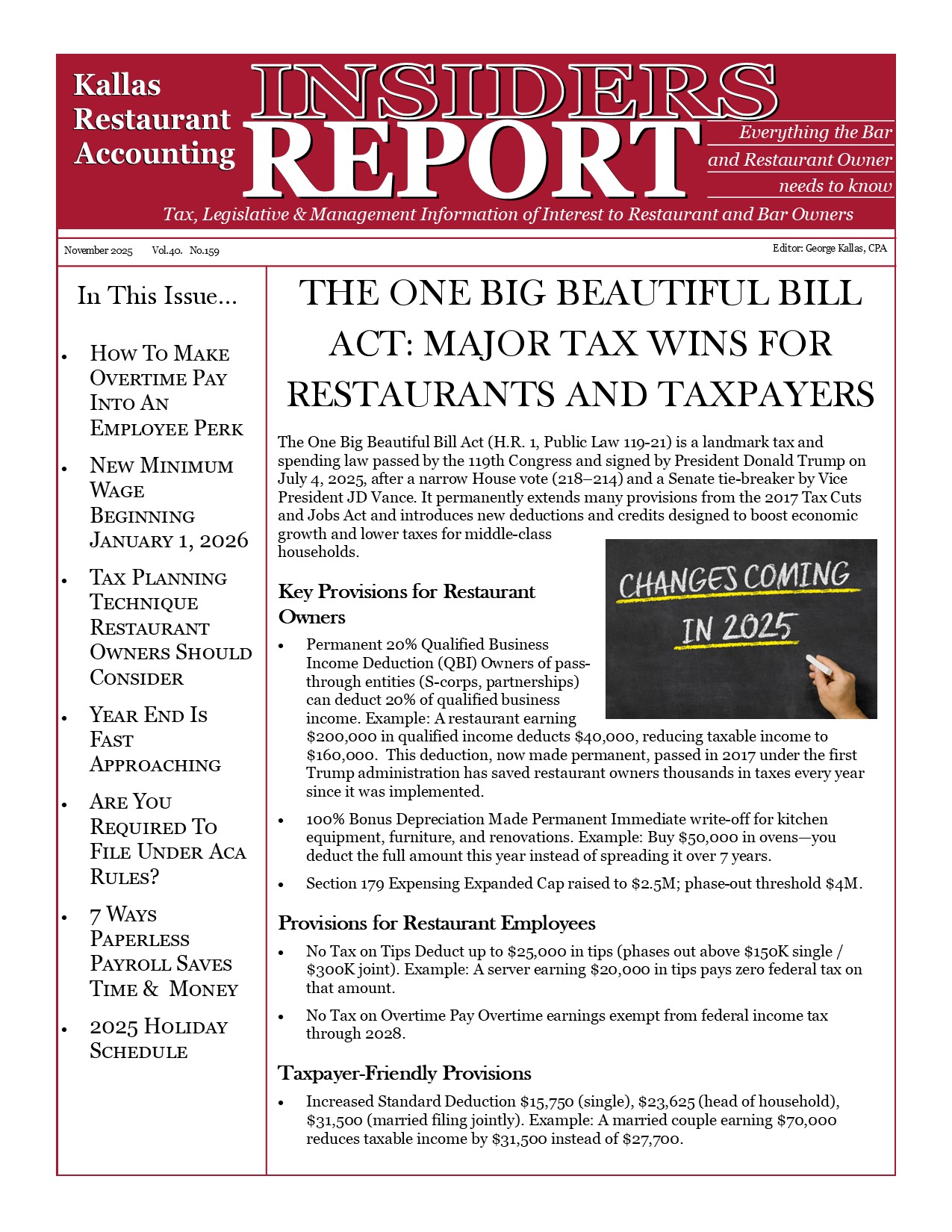
The One Big Beautiful Bill Act (H.R. 1, Public Law 119-21) is a landmark tax and spending law passed by the 119th Congress and signed by President Donald Trump on July 4, 2025, after a narrow House vote (218–214) and a Senate tie-breaker by Vice President JD Vance. It permanently extends many provisions from the 2017 Tax Cuts and Jobs Act and introduces new deductions and credits designed to boost economic growth and lower taxes for middle-class households.
✅ Key Provisions for Restaurant Owners
- Permanent 20% Qualified Business Income Deduction (QBI)
Owners of pass-through entities (S-corps, partnerships) can deduct 20% of qualified business income.
Example: A restaurant earning $200,000 in qualified income deducts $40,000, reducing taxable income to $160,000. This deduction, now made permanent, passed in 2017 under the first Trump administration has saved restaurant owners thousands in taxes every year since it was imprlimented. - 100% Bonus Depreciation Made Permanent
Immediate write-off for kitchen equipment, furniture, and renovations.
Example: Buy $50,000 in ovens—you deduct the full amount this year instead of spreading it over 7 years. - Section 179 Expensing Expanded
Cap raised to $2.5M; phase-out threshold $4M.
✅ Provisions for Restaurant Employees
- No Tax on Tips
Deduct up to $25,000 in tips (phases out above $150K single / $300K joint).
Example: A server earning $20,000 in tips pays zero federal tax on that amount. - No Tax on Overtime Pay
Overtime earnings exempt from federal income tax through 2028.
✅ Taxpayer-Friendly Provisions
- Increased Standard Deduction
$15,750 (single), $23,625 (head of household), $31,500 (married filing jointly).
Example: A married couple earning $70,000 reduces taxable income by $31,500 instead of $27,700. - Senior Bonus Deduction
Additional $6,000 per person over 65 ($12,000 for couples), phasing out at $175K single / $250K joint.
Example: A retired couple with $40,000 income and Social Security can offset most taxable benefits. - Auto Loan Interest Deduction
Deduct interest on U.S.-assembled vehicles (up to $10,000) purchased new in 2025, phases out above $100K single / $200K joint. - SALT Deduction Cap Raised
Increased to $40,000 for taxpayers earning under $500K; reverts to $10K after 2029. The SALT deduction previously limited high-income taxpayers to a total of $10,000 on their itemized deductions for state and local taxes. - Child Tax Credit Boost
Permanently increased to $2,200 per child, with a temporary bump to $2,500 through 2028.
✅ Other Provisions
- Trump Accounts: $1,000 “baby bonus” savings account for every newborn.
- Estate & Gift Tax Exemption: Raised to $15M per individual ($30M for couples).
- Opportunity Zone Incentives: Expanded for distressed communities.
✅ Income Limitations
- Tips & Overtime Deduction: Phases out above $150K single / $300K joint.
- Senior Bonus Deduction: Phases out above $175K single / $250K joint.
- Auto Loan Interest Deduction: Phases out above $100K single / $200K joint.
✅ Why It Matters
For business owners, these deductions mean more capital for growth and lower taxes. For employees, higher take-home pay improves retention and lowers their taxes. For families and seniors, expanded credits and deductions ease financial strain during inflationary times and lowers their taxes.